Monthly Archives: August 2015

Beginner’s Guide to Selecting a Single Malt Whisky

Single Malt whisky guide

Following up on my how to host a whisky tasting article, I thought I’d provide some suggestions of popular, commonly-available, and highly-ranked single malt whiskies in each of the identified flavour Super Clusters.

First thing to do is to familiarize yourself with the characteristics of the individual flavour clusters and super clusters – which you will find described at the bottom of my Flavour Map page. I don’t recommend you get caught up on geographical regions in Scotland (although I will provide classical details below) – it’s far more important to characterize single malts by the flavour characteristics identified through the cluster analysis.

I am going to go through the Super Clusters in the order I recommend when hosting a whisky tasting. That is, starting with the most delicate whiskies and working up to the more complex ones. If you are new to whisky, I also recommend you work your way up the “winey” flavoured whiskies before trying the “smokey/peaty” ones. For those of you more visually-inclined, I’ve posted this commentary as a YouTube video:


Super Custer G-H

  • Dalwhinnie 15 year old is one of the gentler drams, highly ranked in my metacritic database for this super cluster. It’s a Highland whisky with dominant notes of honey and heather/floral aromas. Very easy to drink, and popular with newcomers to single malt whiskies in my house.
  • Glenmorangie 10 year old “original” is perhaps the quintessential delicate whisky that most would be familiar with. Also a Highlander, this is the base spirit that goes into all the more “winey” cask-finished expressions from Glenmorangie (which I personally prefer). But this basic expression does have fans in its own right.

Super Cluster E-F

  • Auchentoshan 12 year old gets a somewhat middling score in my database, but you can’t beat the price – a very good budget whisky. From the Lowland region, it has a delicate base spirit, but has picked up some caramel notes from its time in wood. Fairly dry, it also goes over very well with newcomers to single malts.
  • Redbreast 12 year old is not actually a single malt, but rather an Irish single pot still distillation of malted and unmalted barley. Regardless, it is a good single malt whisky-like dram. Somewhat bolder in flavours and mouthfeel, it is a very highly ranked (and inexpensive) example of this super cluster. Worth venturing across the Irish sea for.

Super Cluster A-B-C

  • BenRiach 12 year old matured in sherry wood is a good introduction to the effects of sherry wood aging on single malts. The base spirit of this Speysider is fairly delicate, so you can really taste the sherry without having overwhelming whisky complexity. A good budget place to start on your heavily “winey” single malt journey.
  • GlenDronach 12 year old “original” is a bolder example of this super cluster, with a stronger range of flavours present (sometimes described as more “meaty” or “savoury”). Technically a Highlander, this one is a lot older than it first appears (as you will see explained in my linked commentary above). Definitely greater complexity than the BenRiach.
  • Aberlour A’Bunadh is a cask strength Speyside whisky (~60% ABV), produced in specific batches (mine is lot 49, but lot 50 is more commonly available now). You will definitely want to add some water to this one, as the full strength effect can be overwhelming. Helps to show off not just the red fruit flavours from sherry wood aging, but the cholocate/mocha richness as well.

Super Cluster I

  • Highland Park 12 year old should probably be in everyone’s whisky cabinet. A good all-rounder from Scotland’s most northerly distillery, on the island of Orkney. A mix of light smokey flavours and sherry, Highland Park is distinctive for its unique lightly peaty characteristics. While the 12 year old won’t win many awards, it illustrates the base characteristics of this distillery well. A poor man’s version of the popular (and much more complex) 18 year old.
  • Talisker 10 year old is a great example of this cluster (especially if sherry is not your thing). Talisker is a peated whisky from the Isle of Skye, and again has some distinctive regional characteristics (described by some as a distinctive sea-air “minerality”). Highly ranked in my metacritic database.
  • Ardmore Traditional Cask gets a somewhat more middling rating in my database, but is great NAS budget choice in this class. Very smokey without being peaty (if that is possible), and more interesting than the similarly priced entry-level Bowmores, in my view.
  • Oban 14 year old is another Highlander like the Dalwhinnie, with similar honey and floral notes. But the Oban is probably more typical of the Highland style, with distinctive smokey notes as well. A bit pricey, which I suspect contributes to its more middling score in my metacritic database. But probably my favourite all-rounder of the four listed here.

Super Cluster J

  • Lagavulin 16 year old is currently my favourite Islay whisky in this class, but it isn’t cheap. A rich flavour explosion, I’ve heard it described as the “depth charge” of whiskies – very popular with experienced drinkers for its complexity and long finish. However, you are likely to smell like a walking ashtray for the rest of the evening (and maybe still the next morning) – so you should warn your significant other before opening a bottle.
  • Laphroaig Quarter Cask (and 10 year old) are two of your best budget Islay offerings in this class. Intensely smokey and peaty, I don’t find there is much else going on here – but some seem to really like these. The QC is better in my view (and the metacritics), and is oddly cheaper here in Ontario – go figure! Great value if you are a fan of smoke/peat.

Of course, those are just starting points for you. Please explore the full Whisky Database for additional options in each flavour cluster.

Alberta Premium

Some things mystify me in the whisky reviewing world (okay, many things!). When looking into entry-level expressions, sooner or later I come across a reviewer who just seems to love one of these cheap budget products. Now, in the case of the entry-priced Canadian Club 100% Rye, I could understand that – it is actually an impressive quality product, clearly priced low to gather attention. But outside of the fictional Don Draper, I can’t imagine anyone actually recommending standard entry-level Canadian Club (aka “CC Premium”) as a top-pick in the world of whisky.

The recently discussed Alberta Premium Dark Horse is another example of an excellent bargain, as it is typically priced just a few dollars more than the base Alberta Premium. But what to make of the entry-level Alberta Premium? Identified as a straight 100% rye grain whisky, Alberta Distillers explains on its website that it is a blending of two whiskies, one of which is a “flavouring whisky” that was aged in used bourbon casks. The final product has apparently been aged for 5 years.

For an entry-level expression, Alberta Premium has an impressive Meta-Critic Score – a just slightly below average 8.37 ± 0.51, based on 9 reviews. Could a mass-produced Canadian rye whisky really compete on that scale, across all whiskies in the database?

The tip-off that something unusual is going on here is the fairly large standard deviation above. Basically, two reviewers love it, putting it in the top ~15-20% of all their whisky reviews. One reviewer finds it about average. The rest didn’t care for it much – with four putting it in the bottom ~15-25% of all whiskies tasted. I describe a slightly more balanced example of this divergence phenomenon with the Glenfiddich/Glenlivet 18 year olds here. In the case of AP, I personally have to side with the majority opinion and consider this to be one of the least interesting rye whiskies I’ve tried.

That said, I don’t find anything seriously wrong with it. For me, many whiskies at this price point are marred by undesirable characteristics in either the nose or finish (and would most likely benefit from extended aging to help smooth out the base spirit further). Although Mrs Selfbuilt reports a distinctly chemical solvent smell and taste to AP, I find it to be relatively inoffensive (for this entry level class). I just don’t see what there is to recommend it. Given its somewhat bland nature, I can only presume AP is designed to appeal to those who plan to use it as a rye for mixed drinks (given its lack of a strong character, one way or the other).

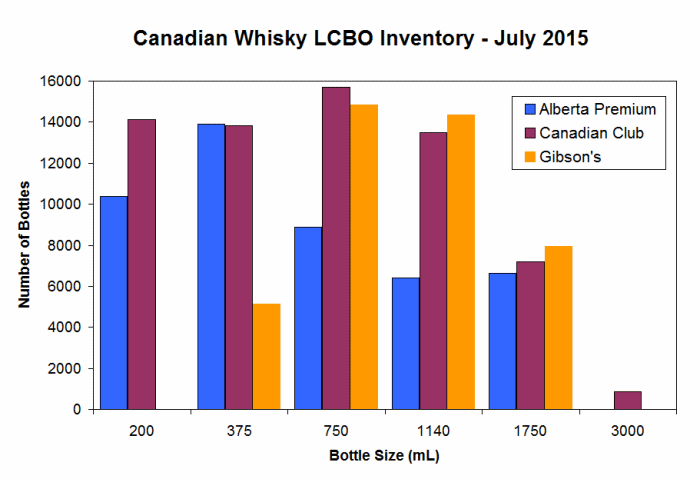
But there is one thing that is distinctive about Alberta Premium – the distribution of bottle sizes. I recently did an analysis of Canadian whisky inventory at the LCBO. Like most entry-level Canadian whiskies, Alberta Premium is available in a wide range of bottle sizes. However, unlike the industry heavyweights, the distribution of sizes for AP is skewed to smaller-than-typical bottles. Here is a comparison to the entry-level expressions from Canadian Club (Premium/Classic) and Gibson’s (12yo/Sterling):

Canadian whisky bottle size distributionMost high-volume distillers offer their entry level products in patterns similar to Canadian Club (roughly equivalent numbers of different size bottles) or Gibson’s (weighed toward larger bottle sizes). AP differs in that it offers a proportionally large share of smaller sized bottles, at least in Ontario.

Alberta Premium bottleOne possible inference from this is that the other makers already have significant market share, and are thus able to more easily sell large bottles of their product. In this interpretation, AP may be trying to get people to taste their product by offering it predominantly in smaller bottles. After all, you are more likely to take a chance on new product if it is in a small bottle at a lower price. Of course, the opposite interpretation would be that they may figure their best option to sell the stuff is by keeping the price particularly low to move inventory. 😉

In any case, to get some contrasting views of Alberta Premium, please check out the Quebec Whisky site. Whisky Won is another review site that I think has the measure of this whisky.

Alberta Premium Dark Horse

Albera Premium Dark Horse bottle

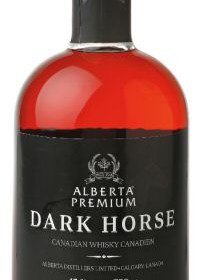
Alberta Premium Dark Horse is a very distinctive offering in the Canadian landscape.

Known for their expertise in producing 100% rye whiskies, Alberta Distillers has produced an unusual beast with their Dark Horse (also known as Alberta Rye Dark Batch in the US, due to copyright issues with the dark horse name).

Alberta Distillers has been up-front about what is in here. Most of the bottle (~90%) is a mix of two types of Canadian rye whisky: High ABV rye aged for 12 years in used barrels, and low ABV pot still rye aged for 6 years in new barrels. Rounding out all that rye whisky is ~8% of US-made bourbon (believed to be Old Grand-Dad – we’ll get back to this in a moment). But the really distinctive element is ~0.5-1% sherry added directly to the mix. The final whisky is then aged in heavily-charred American oak barrels, bottled at 45% ABV, and sold at a very competitive price.

While the addition of actual sherry into the mix may seem like a cheat to single malt fans, it is the net effect of traditional aging of whiskies in ex-sherry casks. I’ve seen estimates online that 500L first-fill casks can contain up to 7L of the previous product (stored in the wood staves). Over time, this migrates and mixes with the new make product, producing a distinctive end result (i.e., a sherry bomb whisky). Rather than aging Dark Horse in (expensive) first-fill sherry barrels, they went right to the horse’s mouth (sorry!) and simply added in an equivalent amount of actual sherry before aging in traditional barrels. This makes Dark Horse a sherry-bomb version of a Canadian rye whisky.

But what about the main elements of the mix, specifically that corn whisky? Note that despite the “rye whisky” moniker, most Canadian whisky is actually a blend of a relatively small amount of low-proof rye “flavouring” whisky added to high-proof grain whisky. Sometimes that includes Canadian-made corn whisky in the mix.

While this composition may seem odd, it makes perfect sense once you know about the 9.09% rule. A long time ago, it was decided that you could add 1/10 volume of non-Canadian whisky to a Canadian whisky and still allow it to be sold as such. Legend has it that this was to allow Canadian whisky to be sold in the US under generous tax break exemptions given to US products. Basically, Canadian distillers would import cheap US-made Bourbon, add it to Canadian whisky (up to 9.09% final volume, which is an additional 1/10) and then sell the concomitant blend back in the US as “Canadian whisky” and reap a tax break.

Here in Canada, there was no need to actually use US bourbon. Apparently, distillers just kept the original Canadian formulations intact for the products intended for domestic consumption. This was possible since the US versions were adjusted to match the standard Canadian flavour profile. But this practice seems to only have been applied to value blends destined for mixing – premium products are a different story.  While it was initially reported that Dark Horse would be using Canadian corn whisky (done bourbon-style), this was quickly corrected by Beam-Suntory, who were open about the use of US bourbon from the beginning.  At some point, they also confirmed that it was Old Grand-Dad bourbon specifically (although I can’t find an official published source for that).

FYI, there’s a good public article about the 9.09% rule – as it applies to the US-release of this whisky – by Davin de Kergommeaux on Whisky Advocate.

Personally, I find the Dark Horse to be an exceptionally good value in the Canadian whisky landscape. The Meta-Critic database seems a bit mixed on this one though, giving it an 8.67 ± 0.36 on 11 reviews. While that is above average for a Canadian whisky, it is still toward the mid-range of scores in this category. But you can’t beat the price – along with CC 100% Rye, this is a quality product masquerading at an entry-level budget price. It is different though, so I would recommend it to fans of Canadian rye who are looking to expand into new flavour profiles.

Probably the most positive review I’ve seen of the Alberta Premium Dark Horse is by Davin de Kergommeaux. Jason Hambrey gives a more typical rating on his Whisky Won site.Albera Premium Dark Horse bottle

Something else that stirs up mixed feelings about this whisky – its suitability for mixed drinks (sorry for the pun). 😉 Because of the strong sherry influence, I would have thought that this whisky is best served as a gentle sipper (preferably neat). Dave Broom seems to agree – in his mixed-drink book The Whisky Manual, he gave this whisky relatively low scores when mixed with five classic mixes (i.e., Soda, cola, ginger ale, coconut water and green tee). But he does point out that it could work well in a sazerac style cocktail. According to David de Kergommeaux in the earlier link above, Dark Horse has apparently become a popular mixing rye in bars, as well as a bartender’s favourite for their own concoctions. Hopefully you will enjoy experimenting with this versatile and distinctive Canadian whisky.