Monthly Archives: December 2015

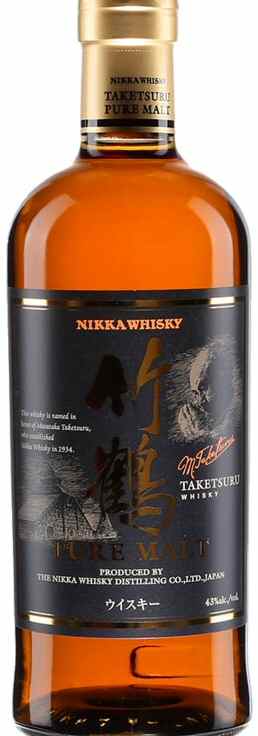
Nikka Taketsuru NAS

As part of their restructuring earlier this year, Nikka has discontinued many of the entry-level age expressions of their major lines. These have been replaced with no-age-statement (NAS) offerings, including for the flagship Taketsuru line.  Fear not, the 17yo and 21yo age expressions are continuing, but you can no longer get the 12yo – it has been replaced by the NAS in retail channels.

As a result, I thought it would be worthwhile to see how it compares to the 12yo I still have on hand. 🙂

As I explained in my earlier Taketsuru 12yo and 21yo review, this line is named after Masataka Taketsuru – one of the key people in the history of Japanese whisky production, and the founder of Nikka. These whiskies are examples of what is known in Japan as “pure malts”, as they blend together malt whisky from multiple distilleries under Nikka control. This is largely a semantic distinction to “single malt”, which refers to whiskies that are blended together from a single distillery (see my Single Malts vs Blends page for more info).

So, how does the new NAS version compare to the 12yo it is replacing? Here are the stats from my Whisky Database:

Taketsuru 12yo: 8.28 ± 0.30 on 12 reviews
Taketsuru NAS: 8.15 ± 0.61 on 3 reviews

Keep in mind the relatively low number of reviews on the new NAS.  While suggestive of reduced quality on the NAS version, it is hard to know until more reviews come in.

Having personally done a head-to-head (nose-to-nose?) comparison of the two, here are my general observations:

Nose: The NAS is a whole different experience from the 12yo.  I had previously observed that the 12 yo had a nice and clean nose, with no off-putting aromas (although it was a little boring).  The NAS, in contrast, has a pleasant sweetness to it, with both a sweet oaky aroma and the definite smell of berries.  I was pleasantly surprised by this development, and was looking forward to the (relatively rare) possibility that this new NAS could actually exceed the original age statement.

Taketsuru.NASPalate: And this is where that optimistic hope was quickly dashed. 😉 The NAS is very light tasting, almost watery in fact (despite the higher 43% ABV).  It definitely lacks the complexity of the 12yo, and feels like much younger spirits are being used. Particularly disappointing to me is the subtle smokey note of the 12yo is completely gone now – this is a very basic malt on the palate, with less going on.

Finish: I previously found that the 12yo had a disappointingly quick finish, turning slightly bitter on the way out. The same is true for the NAS – it turns into a completely forgettable experience fairly quickly after sipping.

To wrap things up, while the nose of the NAS is nice (and beats out the 12yo in direct comparison), the taste of the whisky is less interesting. While I always felt the 12yo deserved a slightly higher score than the consolidated Meta-Critic average, I definitely agree with the slightly lower relative ranking of the NAS version in comparison.

Price-wise, I was able to find the standard NAS 700mL bottle for about 2500 Yen in Tokyo last month (~$30 CAD). Currently not carried at the LCBO, but the SAQ has it for $83 CAD (which seems a bit steep). I bought the old 12yo at the LCBO in mid-2014, when it was $70 CAD. Note that in Japan you can also easily find the smaller 50mL, 200mL and 500mL NAS sizes as well. Prices are described on my Whisky in Japan article.

Given its wide availability, hopefully there will be more reviews on this NAS soon. In the meantime, I recommend you do not rely on reviews of the 12yo as a proxy for this new NAS – it really is a completely different whisky.


Crown Royal Northern Harvest Rye

It is very rare to have a relatively entry-level rye whisky fly off the shelves – but that is what you get for being named “world whisky of the year” by Jim Murray. 🙂

A new product from Crown Royal, Northern Harvest Rye is a blended Canadian whisky composed of 90% rye. Priced attractively at ~$30 CAD, it is now virtually impossible to find it here in Ontario. Indeed, despite having secured the largest allocation of this product in Canada, the LCBO has just taken the extraordinary step of removing the direct inventory link for this item from its website.

Having personally tracked inventory patterns for several weeks now, it appears the LCBO is consolidating shipments. That is, only a single store in any given geographical region gets a delivery – but with a sizable allotment of bottles when it comes. These focused deliveries have been revolving through the local stores in my area, with no advance warning (according to those outlets). Yet despite this, any store that receives a shipment sells out within hours – due to word quickly spreading by social media (which is how I finally managed to find a bottle).

So, does the whisky live up its hype? Given the interest, I thought I’d do a full review with detailed tastings notes before exploring the whisky database results in more detail. On that front, I will also present a statistical analysis and discussion of Mr Murray’s scoring patterns later in this review. 😉

Nose: This is a fragrant whisky  – I could smell it while pouring the glass, at counter height. The overwhelming aroma is one of sweet apple – red apples, green apples, pear apples, etc. There is a creamy sweetness overall, with some notes of caramel and vanilla. You also get some of the classic rye “baking spices”, especially nutmeg, but these aren’t overly strong. Taken together, this is a veritable baked apple pie in a glass! There are additional fruit notes present (e.g., berries, cherries, etc.), but I find they take a back seat. If you search for it, you might be able to detect a slight acetone smell – but its well buried below the fruit.  Initial impression is quite favourable, but the candied sweetness may be off-putting for some (i.e. it smells like it is part apple liqueur).

Palate: Bold and fruit-forward, with all the initial hallmarks of a good Canadian rye whisky. I find the apple (while still present) is mercifully subdued now, and the other fruits quickly come to the surface (especially red fruits and berries). Butterscotch/caramel and vanilla are also more prominent, and the rest of the classic rye baking spices show up – including cinnamon, cloves, nutmeg, ginger and all-spice. Maybe even cardamon – there’s something that reminds me of chai masala here (i.e., black tea with Indian spices and milk). There is also definite oak now, which I found was missing on the nose. The only problem for me is the bitterness which comes in at the end (think strong grapefruit) – it’s quite prominent, and ruins what would otherwise be a consistently top-tasting Canadian rye blend.

Finish: Unfortunately, the bitterness that develops at the end of the palate is slow to clear – and when it does, so has everything else!  I suppose this encourages you to take another sip, but then you just start the whole cycle over again. Putting this lingering bitterness aside, there is not really that much else going here – the same flavours as the palate, only more subdued and fading. I find the finish to be rather weak, and out of character with the impressively strong nose and palate.

So, how does this whisky compare to other inexpensive (and predominantly rye) Canadian whiskies in my database?

Alberta Premium: 8.35 ± 0.53 on 9 reviews
Alberta Premium Dark Horse: 8.65 ± 0.38 on 13 reviews
Canadian Club 100% Rye: 8.67 ± 0.37 on 7 reviews
Forty Creek Copper Pot Reserve: 8.71 ± 0.41 on 12 reviews
Crown Royal Northern Harvest Rye: 8.82 ± 0.37 on 10 reviews
Lot 40: 8.89 ± 0.43 on 14 reviews
Wiser’s Legacy: 9.07 ± 0.26 on 12 reviews

This relative reviewer ranking shows pretty clearly where Northern Harvest Rye fits in – which is also pretty in keeping with relative prices (at least at the LCBO). Personally, I would rank Alberta Premium Dark Horse and Canadian Club Chairman’s Select 100% Rye both a bit higher in that list, but the overall ranking seems reasonable.

Let’s see how it does relative to the other well-known Crown Royals:

Crown Royal: 7.72 ± 0.52 on 10 reviews
Crown Royal Black: 8.28 ± 0.56 on 12 reviews
Crown Royal Special Reserve: 8.79 ± 0.62 on 10 reviews
Crown Royal Northern Harvest Rye: 8.82 ± 0.37 on 10 reviews
Crown Royal Monarch 75th Anniversary: 8.91 ± 0.62 on 5 reviews

Corwn.Royal.HarvestInterestingly, Northern Harvest Rye effectively ties with Special Reserve, and rests below Monarch 75th Anniversary (although the number of reviews there is limited). I know there’s a bottle of Monarch waiting for me under the tree this year, so stay tuned for a follow-up review. 😉

Overall, I find this to be a decent Canadian rye whisky, with a lot going for it. I suppose it could be a good choice as a “sipping whisky” – although the overt sweetness on the nose and the bitterness on the finish detract for me personally.

If you want to read more opinions of this whisky, the three highest-scoring reviews in my database come from Jim Murray, Chip the Rum Howler, and Jason of Whisky Won. Personally, my relative ranking would fall closer in line with André, Patrick and Martin of Quebec Whisky. See also Josh of the Whiskey Jug for a slightly lower score and review.

Understanding Jim Murray’s Score

Jim Murray’s annual “whisky of the year” tends to garner a lot attention and controversy – and this year’s top pick has elicited more than the usual hand-wringing online and in the media. Much of the online commentary has been quite negative, with many accusing Mr. Murray of pulling an attention-seeking publicity stunt (see for example the Whisky Sponge).

While all would likely agree that Northern Harvest Rye is an above-average Canadian rye whisky blend for the price, it is a bit hard to understand how anyone could consider this one of the highest ranking whiskies ever – especially such an experienced reviewer like Mr Murray. His 97.5 score and “world whisky of the year” designation thus seem rather over the top!

A thoughtful concern, as expressed on Whisky Won, is that superlative scores by Mr Murray for entry-level Canadian ryes – like Alberta Premium and Northern Harvest – may actually be harmful for the reputation of Canadian whisky world-wide. Many will rush out, keen to try whiskies that routinely exceed 95 points on Mr Murray’s scale – only to walk walk away disappointed by the relative quality in the end.

But are these selections really as surprising as they seem?  What is lacking in many of these discussions is an understanding of how Mr Murray (or any reviewer) actually scores their whiskies.

One the advantages of running a meta-critic analysis site is that I’ve spent a lot of time exploring how individual reviewers score whiskies. As explained here, scoring is simply a way of providing a relative rank to all the samples you have tried. It turns out most reviewers are actually quite consistent to each other in terms of their relative ranking. This is evidenced by the very good typical correlation of each reviewer to the properly normalized meta-critic scores (r=~0.75 across all reviewers). It is also the reason why you are better off just going by the meta-critic score – and not any one reviewer – when assessing overall quality. It’s good to keep in mind the biases and limitations inherent in quality ranking.

Mr Murray is actually something of an extreme case in my database. He has one of the lowest overall correlations to the combined meta-critic score (r<0.50). Indeed, he correlates quite poorly to all other reviewers in my database (paired correlations range from  r~0.10 to r=~0.45 to each reviewer, which are lower than typical). But that doesn’t mean he is entirely inconsistent in his scoring – there can be patterns in how he differs from the other reviewers.

For this simple analysis, I’ve looked at all the whiskies where Mr Murray’s normalized score deviates from the meta-critic score by a considerable margin. Using a cut-off of 1.5 standard deviation units, there are ~75 whiskies (out of >400 tracked) where Mr Murray’s score is that divergent from the combined meta-critic score. In particular, there are ~25 whiskies where he scores well above the norm, ~50 well below.

The larger number of cases where Mr. Murray scores below the norm are almost exclusively all single malt whiskies. These include many popular mid-range and high-end single malts (i.e., the mean and median costs are of these whiskies are higher than typical for my overall database).

In contrast, the smaller number of cases where Mr Murray scores above the norm are predominantly blends – including many Canadian rye whiskies. As you can imagine, the mean/median cost of these whiskies are below typical for the database.

To illustrate, let’s take a look at the top scoring blends in this divergent high-ranking group. To limit the list, I am including only those that make it into the 65th percentile of Mr Murray’s scores (i.e., ones that score 92 and higher). I am also putting them in rank order, from lowest to highest Murray score.

Pendleton Let’er Buck (Canada) – $$ – Meta-critic 8.12 ± 0.45 on 12 reviews
Canadian Club (Canada): – $ – Meta-critic: 7.25 ± 0.97 on 11 reviews
Hiram Walker Special Old Rye (Canada) – $$ – Meta-critic: 8.19 ± 0.42 on 8 reviews
Black Grouse (Scotland) – $$ – Meta-critic: 8.04 ± 0.56 on 15 reviews
Green Spot (Ireland) – $$$ – Meta-critic: 8.65 ± 0.34 on 9 reviews
Jameson’s Whiskey (Ireland) – $$ – Meta-critic: 7.73 ± 0.62 on 13 reviews
Alberta Premium (Canada) – $ – Meta-critic: 8.35 ± 0.53 on 9 reviews
Chivas Regal 25yo (Scotland) – $$$$$+ – Meta-critic: 8.73 ± 0.24 on 7 reviews
Ballantine’s (Scotland) – $ – Meta-critic: 7.66 ± 0.77 on 8 reviews
Johnnie Walker Black Label (Scotland) – $$ – Meta-critic: 8.37 ± 0.41 on 15 reviews
Crown Royal Northern Harvest Rye (Scotland) – $$ – Meta-critic: 8.82 ± 0.37 on 10 reviews

Notice something interesting about relative cost?  With a couple of exceptions, these are mainly entry-level budget blends.  There is thus a very consistent pattern in how Mr Murray deviates from the rest of the review community: whew he differs, he preferentially favours inexpensive blends, and is less impressed with more expensive single malts.

It is clear (from the Meta-critic scores above) that Northern Harvest is a better quality whisky than the other Canadian blends on that list. So Mr Murray may indeed still be providing a personal relative ranking among blends with his scores – it is just that the absolute value of his scores are inconsistent across blends and single malts.

For experienced whisky drinkers, it is hard to reconcile this scoring pattern with a consistent overall ranking across classes. One possible interpretation of the data is that Mr Murray is explicitly factoring price into his scores. There are several reviewers who do this when providing categorical labels (i.e, “must have”, “recommended”, “avoid”, etc). But Mr Murray’s self-reported method for assembling his scores leaves no room for this.

Further, there seems to a preference for budget blends over budget malts in his scoring, so it is not strictly limited to just price. Thus, an alternative interpretation – and one that seems to fit the data the best – is that Mr Murray is applying a different relative scale for his scoring of budget blends than he does to other whiskies (single malts in particular).

To sum up, the apparent inconsistency is not that Mr Murray gives Harvest Rye such an incredibly high score. Rather, it is that he gives so many entry-level blends such high scores to start with. He is thus fairly unique in the whisky reviewing universe, giving a good number of mass-produced budget blends equivalent (or higher) scores than selective smaller batch whiskies – even when made by the same producers.


Holiday Gift Guide 2015 – Ontario

NOTE: This guide has been replaced by a new up-to-date analysis for 2016 – please check it out!

Welcome to my inaugural 2015 holiday gift guide!

You can find plenty of whisky suggestions online – but, of course, the specific selections may not be available to you locally. Given that liquor is controlled through the LCBO in my province, I thought I would highlight high-ranking, affordable whiskies (~$100 CAD or less) currently in stock across the LCBO this holiday season.

Of course, the following would be good choices for you wherever you live. I certainly also encourage you to explore recommendations from other whisky blog sites – but I also suggest you run them through the meta-critic Whisky Database here first, to see how they compare.

Similarly, nothing is stopping you from spending considerably more on whisky than the rather arbitrary cut-off of ~$100 CAD used below. But again, you will want to check the database to see how they score in comparison.

All scores below are listed as the average meta-critic score, plus or minus the standard deviation, on the given number of reviews. Check out by Meta-critic Score page to understand what the meta-critic scoring is all about.

Single Malts

As usual, it’s worth picking single malt whisky by flavour cluster, as described on my Flavour Map page. Specifically, I am going to work from the 5 general “super-clusters” I describe there.

Aberlour.ABunadh.49Super-cluster A-B-C

Full-bodied, very sweet, pronounced sherry – with fruity, floral, nutty, honey and spicy notes, as well as malty and smokey notes on occasion.

My top pick here would normally be the Aberlour A’Bunadh, which gets an impressive 9.02 ± 0.21 on 16 reviews in my database – and is only $95 at the LCBO. That is a steal for this level of consistent quality (and is bottled at cask-strength to boot). Unfortunately, it’s rarely in stock now, with only a handful of bottles showing up in current online inventory. Snag one if you can!

Failing that, your next best bet for a cask-strength sherry bomb is the more widely available Glenfarclas 105. It is a little over my arbitrary limit at $107, and doesn’t score quite as highly – albeit at a still very respectable 8.80 ± 0.39 on 15 reviews.

My budget choice, at $66, is the GlenDronach 12 Year Old. It gets a very respectable 8.66 ± 0.24 on 15 reviews. And don’t let the relatively young age statement fool you – this whisky packs quite a sherried punch (and see my commentary for info on its true age).


Super-cluster E-F

Medium-bodied, medium-sweet – with fruity, honey, malty and winey notes, with some smoky and spicy notes on occasion

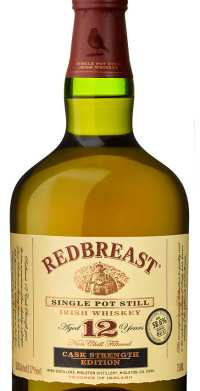
Middleton Redbreast 12yo bottleOne of the highest-ranking budget whiskies in this class is Amrut Fusion, from India. At only $85, and scoring 8.93 ± 0.27 on 17 reviews, this is certainly an excellent choice. It’s also an opportunity for those looking to explore a tropical whisky. Unfortunately, it is not widely available through the LCBO – again, grab one if you can.

My top budget choice in this category is an Irish whiskey, Redbreast 12 Year Old. Redbreast is a single pot still whiskey. This is a traditional Irish style, where both unmalted and malted barley are distilled together in copper pot stills. The end result is closer to a Scottish single malt than a blend. Only $70, it gets a very good 8.83 ± 0.47 on 16 reviews.

A couple of new options at the LCBO you may want to consider are a pair of Glenfiddichs – Distillers Edition 15 Year Old and Rich Oak 14 Year Old. These are not your every-day entry-level Glenfiddichs, but more robust malts. The DE 15yo is currently on sale for $83, and scores 8.76 ± 0.38 on 8 reviews, and the RO 14yo is priced at $66, with 8.71 ± 0.35 on 6 reviews. Given the lower reviewer experience with the malts however, you should treat these scores as provisional.


Super-cluster G-H 

Light-bodied, sweet, apéritif-style – with honey, floral, fruity and malty notes, sometimes spicy, but rarely smoky.

Hibiki Harmony NASA really good choice here is The Arran Malt 14 Year Old. Typically, whiskies in these flavour clusters score lower than other clusters. And so, 8.71 ± 0.29 on 14 reviews in an excellent showing for this class. It’s not exactly cheap at $98 though, nor is it commonly available throughout the LCBO.

As a result, my top pick in this category (and my wife’s personal favourite) is the Dalwhinnie 15 Year Old ($95, 8.65 ± 0.4 on 12 reviews). A fairly delicate whisky, there is a surprising amount of complexity here. It also has lovely honey sweetness to it. Well worth a try.

A back-up budget choice you may want to consider is The Arran Malt 10 Year Old. A bit lighter in flavour than the 14yo, it’s cheaper at $70 – and more commonly available. Gets a decent 8.55 ± 0.41 on 15 reviews.

A different sort of option to consider is the only Japanese whisky currently on the LCBO’s roster – the Hibiki Harmony. Currently $100, its 8.45 ± 0.84 on 9 reviews is an average overall ranking – but one that has a lot more variability than usual (i.e., some really like it, some really don’t). Note that this is a blend, and is relatively delicate in flavour (which is why I am considering it in this single malt flavour super-cluster). But it’s your only chance to get in on the Japanese whisky craze through the LCBO, and I think it is a worthy contender to try (i.e., I personally fall in toward the higher-end of that scoring range). And it was just named as Japanese Whisky of the Year at WhiskyAdvocate.com.


Talisker 10yo bottleCluster I

Medium-bodied, medium-sweet, smoky – with some medicinal notes and spicy, fruity and nutty notes

This is a classic cluster for fans of smoky and/or peaty whiskies – though not out-right peat-bombs (see cluster J below for that).

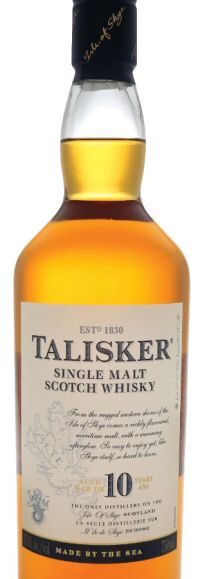
And you would do well to stick with a classic member of this class, the Talisker 10 Year Old. Just squeaking in at $100, it gets an excellent 8.92 ± 0.2 on 15 reviews. Seriously, you can’t go wrong with this choice – anyone would thank you for it.

There are certainly a lot of other options to consider here, but nothing really jumps out at me as a particularly good buy at the LCBO right now (at least, nothing that is commonly available). With moderate availability, I suppose you could consider the Longrow Peated ($98, scoring 8.79 ± 0.27 on 13 reviews), or Springbank 10 Year Old ($99, 8.71 ± 0.30 on 13 reviews), for something a bit different.

A good budget choice – especially if you like a little sherry in your smoky malt – is the Highland Park 12 Year Old ($75, 8.69 ± 0.41 on 17 reviews). Unfortunately, quality seems to have dropped in recent batches, otherwise this one would have been a a top pick. Still, it may serve well for something flavourful in this cluster.


Laphroaig Quarter Cask whisky bottleCluster J

Full-bodied, dry, very smoky, pungent – with medicinal notes and some spicy, malty and fruity notes possible

You really can’t top the value proposition of the Laphroaig Quarter Cask – only $73, yet garnering a meta-critic score of 9.16 ± 0.18 on 15 reviews! That’s a remarkable score, if you are into these really fragrant (aka pungent) peat bombs.

Surprisingly, it’s even cheaper than the standard Laphroaig 10 Year Old expression ($84, 8.92 ± 0.29 on 14 reviews). The Ardbeg 10 Year Old is another consideration for an entry-level expression ($100, 8.99 ± 0.37 on 15 reviews).

Of course, there is a lot more to consider if you are willing to go a bit higher. Stretching the budget a bit, my personal favourite, at $122, is the Lagavulin 16 Year Old. It gets an incredible meta-critic score of 9.36 ± 0.24 on 19 reviews. Full of a wide array of rich flavours, I find it a lot more interesting than the younger peat-bombs above. Just be prepared to smell like a talking ash-tray for the rest of the evening!


Scotch Blends

There are a lot of great blends out there, most of which can be had for much less than a typical single malt.

Why not move beyond the well-established names, into the company that has made the most waves in recent years – Compass Box.

Right now, you can fairly easily find the Great King St Glasgow Blend at $58, scoring 8.75 ± 0.12 on 5 reviews, or Great King St Artist’s Blend at $55, scoring 8.73 ± 0.34 on 11 reviews.

There is a lot more to consider here – especially for those on a tighter budget – so I suggest you explore the Whisky Database in more detail.


Lot 40 canadian rye whisky bottleCanadian Rye Whisky

Ok, you are NOT going to be able to find Jim Murray’s “World Whisky of the Year” – Crown Royal Northern Harvest Rye – very easily at your local LCBO. Due to its popularity, it sells out almost instantly whenever a LCBO store gets it in stock. It is attractively priced (on sale for $30), and gets a very good score of 8.81 ± 0.37 on 7 reviews.

But it certainly is not the highest ranked Canadian whisky overall by reviewers  – indeed, it is not even the highest ranked Crown Royal! That honour goes to the Crown Royal Monarch 75th Anniversary ($60, 8.92 ± 0.62 on 5 reviews). You may want to consider that rye blend as a possible consolation prize.

The highest-ranked Canadian whisky in my database is actually Gibson’s Finest 18yo: 9.11 ± 0.41 on 8 reviews – and currently on sale for $67 at the LCBO. A great blend of flavours, and one of my favourite Canadian whiskies. Highly recommended, if you can find it (may need to hunt around several stores in your area).

Wiser’s Legacy is a solid second choice, with 9.07 ± 0.26 on 12 reviews – and regularly-priced at $50. It has a spicier rye flavour, and is a great introduction to that classic Canadian style.

But a personal favourite that I like to recommend to newcomers to Canadian whisky is Corby’s Lot 40. A straight rye whisky that has been extensively reviewed, it gets a very good 8.89 ± 0.43 on 14 reviews – and is quite affordable at $40. One of the best aromas you will find.

Personally, I would go for any of the three higher scorers above, before any of the Crown Royals.


American Bourbon

Sadly, Ontario is not a good place to find higher-end American bourbons (although you can certainly get a good selection of the more entry-level and lower mid-range stuff).

1792Knob Creek Single Barrel Reserve ($57, 8.89 ± 0.34 on 5 reviews) and Maker’s Mark 46 ($58, 8.89 ± 0.23 on 11 reviews) would be among the top picks for mid-range bourbons, and both are at least somewhat available. Note that the Knob Creek Single Barrel is at cask-strength (60%), and Maker’s Mark is a “wheater” (i.e., mainly wheat-based for the secondary ingredient in the mashbill, after corn).

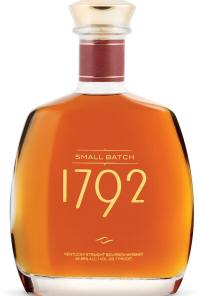
1792 Ridgemont Reserve Bourbon ($50, 8.78 ± 0.33 on 10 reviews) is a good option for those looking for a bit more rye spice in their bourbon, and comes in a nice decanter bottle. Probably the safest “gift” choice for a nice-looking bourbon (given that Blanton’s is not widely available at the LCBO).

Of course, maybe you are simply looking for a good quality “house” bourbon? Elijah Craig 12 Year Old ($43, 8.76 ± 0.36 on 12 reviews), or Buffalo Trace Bourbon ($41, 8.61 ± 0.44 on 14 reviews) would be top picks in that category, and widely available.

There’s a lot more to consider here – it really depends on your tastes. But I find inventories are kept so low on many popular bourbons, that there is really no point in discussing them in too much detail. You are best to see what is available locally, and then check the database to see how they perform.

—-

Again, whatever you choose to get, I strongly suggest you use the Whisky Database to see how it compares to other options in its respective flavour class.

Slainte, and happy holidays!



Aberlour A’Bunadh – batch 49

Welcome to one of the best known “sherry bombs” – the Aberlour A’bunadh.

From Gaelic, a’bunadh means ‘(of) the origin”, or “the original”, and is meant to honour an earlier style of whisky making at the speyside distillery Aberlour. Pronounciations are always tricky, but the full name of the distillery and whisky would best be pronounced a-ber-LAU-er ah-BOON-ar.

A’bunadh is a cask-strength single malt, produced in limited run batches. For this reason, each batch has a batch number instead of an age statement, with a variable absolute alcohol by volume (typically, ~59-61% ABV). They make several batches a year.

One of the distinctive features of A’bunadh is the exclusive aging in first-fill Spanish oak Oloroso sherry butts. I’ve seen various estimates online, but it appears that each batch is blended from barrels in the 5-25 year old range. Note that while it is widely believed that there is significant batch-to-batch variability (see below), all would qualify as “sherry bombs”, given the exclusive sherry cask aging.

Given the heavy focus on statistics on this blog site, an interesting question is how best to incorporate the batch-based A’bunadh into the meta-critic whisky database?

Given the large number of batches each year – and the corresponding limited number of reviews for each batch – I initially considered simply collecting scores on a per reviewer basis. So, if a reviewer had sampled multiple batches, I would average their scores across those batches (thus producing a single score per reviewer). As always, I would limit batches to those produced in the last ~5 years or (i.e., from batch ~30 and on up), to be consistent with other whiskies in the database.

Now, you could argue that this method would obscure any underlying pattern in natural batch variation. So I decided to first look at reviewers who had scored multiple batches. Surprisingly, I found very low variation across batches from each of these reviewers. Indeed, for reviewers who had scored a good number of A’bunadh batches (n>6), the standard deviations of their scores varied from ~0.10 up to ~0.25, per reviewer. Thus, despite the commonly held view that individual batches of A’bunadh are highly variable, you don’t see much variance in scores among at experienced reviewers. As such, I think it is worthwhile considering what an average across batches looks like, for all reviewers:

Aberlour A’Bunadh (all batches): 9.02 ± 0.21 on 16 reviewers

Clearly, this is a popular whisky, with a well above-average meta-critic score for its class (cluster A, of the ABC super-cluster).  It also has a below-average standard deviation across reviewers, compared to other whiskies in my database.

But that isn’t the end of the story – you need to consider all patterns in the data. Specifically, while reviewers generally look favourably on all batches of A’bunadh, they do have their relative preferences. And more importantly, there seems to be some consistency in the relative rankings across reviewers.

To explore what I mean by that, let’s take a look at all A’bunadh batches scored individually, across all reviewers. For this, I am only reporting below modern batches for which I have at least 4 individual reviews.

Aberlour A’Bunadh (Batch 30): 9.00 ± 0.17 on 6 reviewers
Aberlour A’Bunadh (Batch 32): 8.89 ± 0.72 on 4 reviewers
Aberlour A’Bunadh (Batch 33): 9.18 ± 0.16 on 4 reviewers
Aberlour A’Bunadh (Batch 34): 8.93 ± 0.32 on 5 reviewers
Aberlour A’Bunadh (Batch 35): 9.06 ± 0.24 on 5 reviewers
Aberlour A’Bunadh (Batch 36): 9.05 ± 0.52 on 4 reviewers
Aberlour A’Bunadh (Batch 39): 9.12 ± 0.24 on 6 reviewers
Aberlour A’Bunadh (Batch 47): 8.88 ± 0.41 on 5 reviewers
Aberlour A’Bunadh (Batch 48): 8.84 ± 0.57 on 4 reviewers
Aberlour A’Bunadh (Batch 49): 9.24 ± 0.08 on 6 reviewers
Aberlour A’Bunadh (Batch 50): 8.81 ± 0.42 on 4 reviewers

Keeping in mind the relatively low number of reviews, you can see that almost all of these fit quite well within the overall mean and SD of the all-batch data presented earlier (which is, by definition, based on the largest number of reviewers). But one batch really stands out for me, as it is a full SD unit from the overall mean – batch 49.

As you can see above, batch 49 gets the highest score (9.24) and lowest standard deviation (0.08) of any specific batch in my database. More than that, when looking over percentile rankings for the five reviewers who have tried multiple batches including this one, batch 49 is consistently their highest ranked A’bunadh version.

Below is what I find in the glass for this batch. Again, expect some variability from batch to batch, but all should fall within a general flavour range:

Nose: Big and bold sherry flavours, with raisins, figs and chocolate most prominent. Some other dark fruits are below the surface (e.g. cherry), but you will need some water to bring them out. Neat, there is a fair amount of alcohol burn here (i.e. it singes the nose hairs if you inhale too deeply). Water helps on this front as well.

Palate: Sweet and delicious, with more of the fruits showing up now – especially cherry and raspberry. Also orange marmalade and dark chocolate. Mouthfeel is thick and oily, with a syrupy nature. Just a touch nutty as well. With water, it opens up further, with rich notes of Christmas cake, fig pudding, and creamy milk chocolate. Becomes like Christmas in glass, including those chocolate orange candies.

Finish: Long. While there is an initial alcohol burn (subdued with water), a fruity sweetness persists for awhile. Unfortunately, a bit of bitterness creeps in over time (almonds? coffee?) – which is the one thing holding this expression back a bit for me.

General consensus on the subject of water is hard to come by here, as it seems that many prefer drinking it neat, at cask strength. Personally, this is one where I think water greatly improves the experience. And not just a few drops – a significant amount of water is actually better. Taking it down to ~50% ABV was my personal sweet spot, taming the burn and bringing out more of the fruit flavours. There were rapidly diminishing returns beyond that though – by ~45% the whisky definitely felt flooded. You will want to experiment to see what works best for you.

Aberlour.ABunadh.49I am glad I was able to pick up a bottle of batch 49 while it was available, and am now on the hunt for samples of other batches to compare. Batch 49 is certainly very flavourful, with no hints of the sulphur that sometimes mars some sherry cask batches. It is an outstanding value for $95 CAD at the LCBO.

To get the experience of those who have sampled many batches, I suggest you check out André, Patrick and RV at QuebecWhisky.com, Serge and WhiskyFun.com, or Ruben at WhiskyNotes.be. Given the generally high scores, it is hard to find a truly negative review of any A’bunadh batch. When it does happen, it is usually due to the detection of sulphur compounds (see for example Oliver’s experience of batch 45 at Dramming.com).

If you can find it, the Aberlour A’bunadh is a strong candidate to consider for the “sherry-bomb” corner of your whisky cabinet.


Nikka Coffey Grain

Japanese whisky follows very closely the model laid down by Scottish whisky production. Specifically, you get malt whisky (made from malted barley using traditional copper pot stills) and grain whisky (which can incorporate various grains – most typically corn – made in a continuous column still). If you mix some portion of these together, you get a blended whisky (or a simply, a blend). See my single malt vs blend discussion here for more info on these categories. Also see my recent Nikka Coffey Malt review for a comparison.

In Scotland, there are plenty of single malts available to occupy the higher-end whisky niche – and so, most blends are relegated to the low end. There are exceptions of course (see Compass Box, for example), but this does serve as a good general rule. The result is that grain whisky production is largely a commodity-driven, high-volume industrial enterprise in Scotland.

One of the key differences to whisky production in Japan is a focus on making high-quality blends (see my Hibiki 17yo and Harmony commentaries, for example). Of course, you can only do that if you take some care in your grain whisky production.

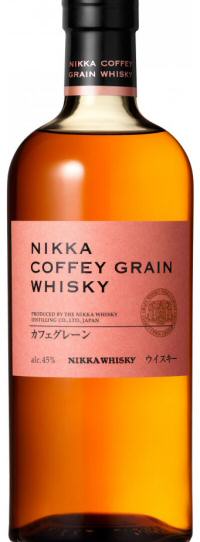
For this commentary, I’m highlighting the standard NAS bottling of the Nikka Coffey Grain whisky. Fairly commonly available (for a Japanese whisky), and reasonably priced (again, for Japanese whisky), this is an unusual beast in the whisky world –  a pure grain whisky. Made at the Miyagikyo distillery operated by Nikka, this corn whisky is produced in a continuous Coffey still – one of two in operation by Nikka for over 50 years now. Bottled at 45% ABV.

The absence of any malt whisky in the bottle means that the Nikka Coffey Grain is in some ways more like a Bourbon than a traditional Scotch. Let’s see what I find in the glass.

Nose: Very much of the corn whisky style. Slightly sweet, like watered-down corn-syrup, with definite traces of its time in oak (i.e., caramel/vanilla aromas, and an overall woodiness). Maybe a bit floral as well. Unfortunately, I also get a noticeable solvent aroma, which I don’t care for personally. All told, the nose reminds me of some of the younger Canadian blended whiskies (e.g. Gibson’s 12yo, Century Distillers Ninety 5yo, etc.).

Palate: Initial impression is all soft, gentle creaminess. It’s pleasantly sweet, in a delicate way – not the heavy corn syrup I sometimes find in bourbons. This is definitely still a Japanese creation, with a pleasant range of flavours – including some spice and some floral notes – all enveloped in a persistent, lightly sweet creaminess. Vanilla and caramel are noticeable, and there is a touch of apple. The faintest hint of that solvent note persists at the end, but it is very subdued (thankfully). All in all, pretty decent.

Finish: Fairly short and thin (as I find common to grain whisky), but carries through many of the same notes from the palate.

It is often said that grain whisky provides that classic “smoothness” to blended whiskies – the way it spreads out over the tongue, evening-out the various flavour components, binding them all together. This is in contrast to the “sharpness” that high-quality malt whisky provides – especially in terms of cascading waves of intense flavour through the palate and finish. The Nikka Coffey Malt definitely shows this “smoothness” well – frankly, I would describe the overall mouth-feel as luscious. 🙂

Truthfully, I don’t really see this whisky as a competitor to most bourbons, given its relatively light character. Instead, I think this whisky would be a hit with fans of the lighter Irish, Scottish or Canadian style of blends – especially if you enjoy a little sweetness.

Here’s how it compares to some other Nikka malt and/or blended whiskies in my meta-critic Whisky Database:

Nikka.Coffey.GrainNikka Coffey Grain: 8.70 ± 0.56 on 12 reviews
Nikka Coffey Malt: 8.76 ± 0.56 on 5 reviews
Nikka Pure Malt Red: 8.55 ± 0.36 on 9 reviews
Nikka All Malt: 8.46 ± 0.2 on 8 reviews
Nikka Super: 8.04 ± 0.43 on 6 reviews

A good above-average composite score at 8.7, with an above-average standard deviation (suggesting a wide range of opinions on this whisky). And I can understand that, given its distinctiveness for the class. While some may enjoy its delicate and smooth characteristics, others may find it relatively bland and uninteresting (or potentially over-sweet). Definitely a cut above most entry level single malts I’ve tried.

Price-wise, I just picked this bottle up in a Tokyo duty-free for 5400 Yen (~$65 CAD). Not available at the LCBO or SAQ, but you can pick this expression up in BC or Alberta for ~$85-90 CAD (which seems like a remarkably good deal for Canada).

For detailed reviews from those who quite like it, check out André and Martin at QuebecWhisky.com, or Jason at WhiskyWon. For some contrasting opinions, check out Serge at WhiskyFun.com or Michio at Japan Whisky Reviews.