Bushmills Original Blended Irish Whiskey

Having reviewed a few mid-range and higher-end Irish whiskies lately, I thought it was time to get back down to basics.
Bushmills Original blended whisky (aka white label) is the flagship for the Bushmills distillery – one of the oldest distilleries in Ireland, having survived the massive consolidation of the 1980s. Although the bottle labels like to point out Bushmills was founded in 1608, the actual licensed distilling company has only existed since 1784. It has certainly moved through a lot hands since then – and was sold a couple of years ago by the large whisky drinks conglomerate Diageo to Casa Cuervo (of tequila fame).
This is a blended Irish whisky – specifically a blend of single malt and cheaper column-distilled grain whisky. This differs from a number of Irish whiskies, like the Midleton brands I’ve reviewed previously, who combine traditional single pot still whisky with grain whisky in their blends. While Bushmills may be thought of as more scotch-like in that sense (i.e., a blend of malt and grain whiskies), it is still triple-distilled like other Irish whiskies (thus producing a typically lighter spirit).
This basic Bushmills expression is bottled at 40% ABV. It is currently $32 CAD at the LCBO, making it one of the cheapest Irish whiskeys you can buy here.
Here is how Bushmills compares to similar entry-level Irish whiskies in my Meta-Critic Database:
2 Gingers Irish Whiskey: 8.05 ± 0.35 on 3 reviews ($$)
Bushmills Original Blended: 7.64 ± 0.49 on 15 reviews ($$)
Bushmills Black Bush: 8.35 ± 0.40 on 20 reviews ($$)
Bushmills 10yo Single Malt: 8.18 ± 0.30 on 19 reviews ($$$)
Glendalough Double Barrel: 8.29 ± 0.40 on 5 reviews ($$)
Jameson Irish Whiskey: 7.82 ± 0.51 on 19 reviews ($$)
Jameson Select Reserve (Black Barrel): 8.37 ± 0.38 on 17 reviews ($$)
Kilbeggan Irish Reserve Malt: 7.98 ± 0.52 on 6 reviews ($$)
Powers Gold Label: 7.99 ± 0.52 on 11 reviews ($$)
Teeling Small Batch: 8.31 ± 0.41 on 19 reviews ($$)
The Irishman Founder’s Reserve: 8.32 ± 0.38 on 6 reviews ($$)
Tullamore Dew Blended: 7.81 ± 0.38 on 17 reviews ($$)
Tyrconnell Single Malt: 8.15 ± 0.39 on 14 reviews ($$)
West Cork Original: 8.01 ± 0.48 on 3 reviews ($$)
As you can see, this is the lowest scoring Irish whiskey in the dataset – although none of the true entry-level expressions do very well. Typically, it is worthwhile considering spending a little more to go up to the next bottling (e.g., Black Bush for Bushmills, Select Reserve for Jameson, etc.).
I sampled this basic Bushmills recently in a bar. While these sorts of entry-level blends are not intended to be drunk neat, here is what I find in the glass when doing so:
Nose: Sweet caramel and light honey. Green apple. Very grainy, with some hay. Surprisingly, some mild ethanol singe, and a slightly funky tar note. Better than it sounds (and better than I expected).
Palate: Way too honeysuckle-sweet for my tastes. Maybe agave syrup? A bit of artificial strawberry flavour (fruit roll-ups come to mind). Incredibly watery, absolutely no burn – and no mouthfeel, while we are at it. Seems very grain-dominated, with almost no sign of the malt. Some light rye spices come up at the end.
Finish: Sickeningly sweet continues, with a touch of eventual woody bitterness. Reminds me of some cheap American whiskies that don’t qualify as bourbon, or maybe regular Crown Royal here. Some astringent dryness too. At least it’s short.
 Again, it should go without saying – if you want to sip on something neat, start with a higher-end blend or a decent single malt/single pot still whisky. As a stand-alone pour, I find Bushmills original blended less complex (and less interesting) than even regular Jameson – and like the Meta-Critic, I would rate it lower. But many may find it more acceptable than Jameson’s in mixed drinks due to the sweetness factor. At a minimum, I would recommend this one on the rocks, to help cut the sweetness.
The only reviewer I’ve ever seen who actually seems like this whisky is Martin of Quebec Whisky, followed by Patrick (although most reviewers are more aligned with Andre’s score). Ralfy, Jim Murray, and Josh the Whiskey Jug all fall into a similar camp of low scores (as an aside, Josh’s tasting notes are remarkably similar to mine on this one). But personally, my own quality assessment is more in line with Nathan the Scotch Noob, Thomas of Whisky Saga or S.D. of Whiskey Reviewer. I strongly recommend spending a couple of dollars more for a better Irish whisky.

 Frankly, I would not have immediately pegged this as a blend – it seems malt-heavy (although the higher strength may be contributing to that perception). This one really needs a little water (and I emphasize, little) to open up all the flavours and tame the ethanol burn.
 Not an overly complex whisky, but easily sippable. The nose doesn’t really do justice to the caramel/vanilla backbone that dominates the palate and finish. I suppose you could say it blends some of the best characteristics of Glenfiddich and Balvenie. Overall, it also reminds me of some of the similarly aged vintage Glenrothes. Perhaps a bit overpriced at the original $190 CAD, but a good deal at the current $90 CAD clearance price, if you ask me.
 Finish: Short to medium. Some lingering sweetness, like slightly flat ginger ale. A bit citrusy. No bitterness or off-putting after-tastes, crisp and clean.
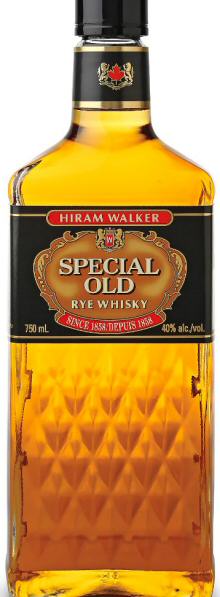 UPDATE JANUARY 2016: Like many bargain Canadian ryes, lot variation can be considerable on these. I recently picked up a second bottle, and find the nose is muted in comparison, especially for the rye spices – and there is a distinct glue-like solvent smell now. The palate is generally similar, but feels “hotter” (i.e., more raw ethanol taste). Finish is comparable, although perhaps a touch less bitter (which would actually be an improvement).
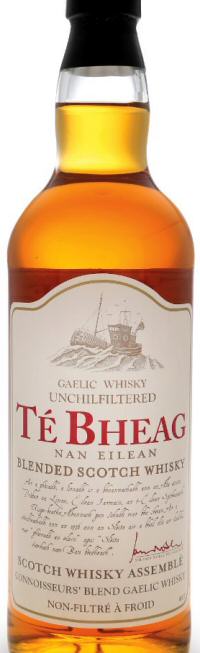 Té Bheag is a great value for what it is – a decent Scotch blend at an excellent price. It has noticeable traces of peated barley and sherry cask finishing – an uncommon combination in an inexpensive blend. Despite the Isle of Skye origin, I could see this as the poor man’s Highland Park. 🙂 Indeed, while it is challenging to equate blend scores with single malts, I am also struck by how well Te Bheag matches the more-expensive entry level HPs, as shown below:
 The nose is misleading on this one, with its pure white sugar sweetness. Once you actually take a sip, this seems more like a decent light Irish whiskey – but with some significant alcohol kick.